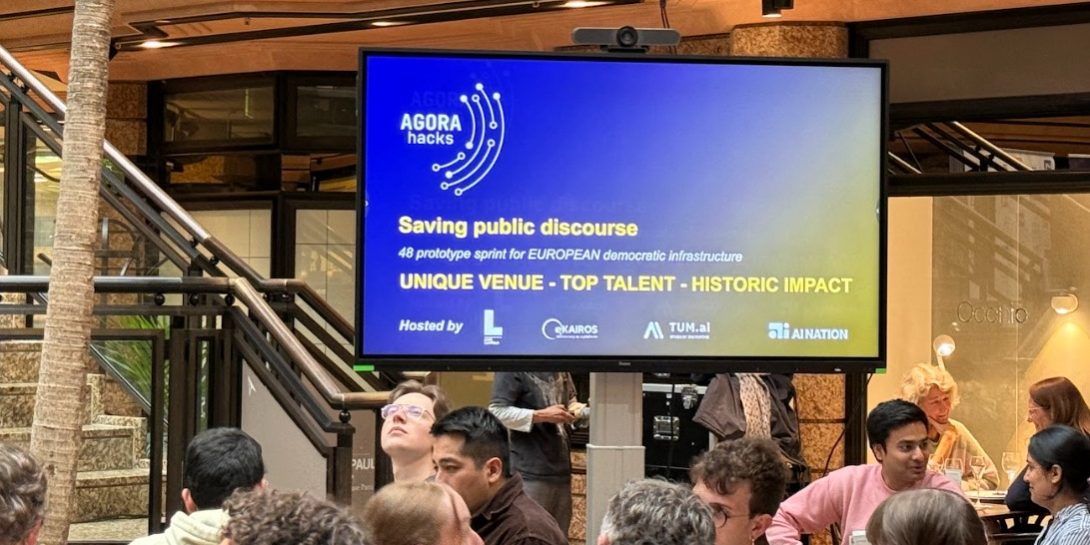
AGORAHACKS 26a_Saving Public Discourse
10.-12.4.26 eKairos c/o SALON Luitpold Building Democratic Infrastructure
Some hackathons begin with code.
Ours began with coffee. That was not a gimmick. It was the whole point.
With AGORAHACKS 26a, eKairos and its partners set out to test a simple but ambitious idea: if democracy depends on public discourse, then public discourse depends on the spaces, norms, and technologies we build. Over 48 intense hours in the heart of Munich, Café Luitpold became exactly that kind of space — part coffeehouse, part laboratory, part civic prototype zone.
What emerged was more than a hackathon. It was a live experiment in how Europe might rethink public discourse, democratic resilience, and collective intelligence with AI and machine learning as enabling tools. As we wrote in the aftermath: yes, it sounds ambitious. It is. But the weekend proved that ambition, when paired with the right people, the right setting and eurostack only technologies, can become momentum.
A remarkable level of interest
The response exceeded all expectations.
We received more than 400 applications and selected 102 participants for the final cohort. They came from across Europe, joined by two participants from Silicon Valley, UK, Switzerland, Tunisia, Morocco, Israel and even three participants from the Burkina Faso Institute of Technology — an extraordinary signal of how widely the question of democratic infrastructure now resonates.
A key success factor was certainly that all four Munich universities — LMU, TUM, the University of the Bundeswehr Munich, and the Munich School of Philosophy — were involved from the very beginning.
What this created was not a niche tech gathering, but a genuinely international and interdisciplinary group: people from tech, design, AI, policy, education, research, and entrepreneurship, all working on one central question: what kind of AI can a democracy trust?
Why this format mattered
What many of us have long felt became unmistakably clear over the course of the weekend: the problem is not a lack of opinions. The problem is the infrastructure in which opinions meet.
Too many digital systems reward outrage over understanding, speed over reflection, and simplification over real listening. AGORAHACKS was designed as a counter-model: a space where technological imagination could meet civic responsibility, and where democratic questions were treated not as branding language, but as design challenges.
For eKairos, this matters deeply. We have long believed that meaningful conversation needs better infrastructure — not just better intentions. AGORAHACKS brought that conviction to life by combining the openness of a coffeehouse with the urgency and productivity of a hackathon. It was an attempt to move from brilliant conversation to actual prototypes, from shared concern to shared construction.
What happened in Munich
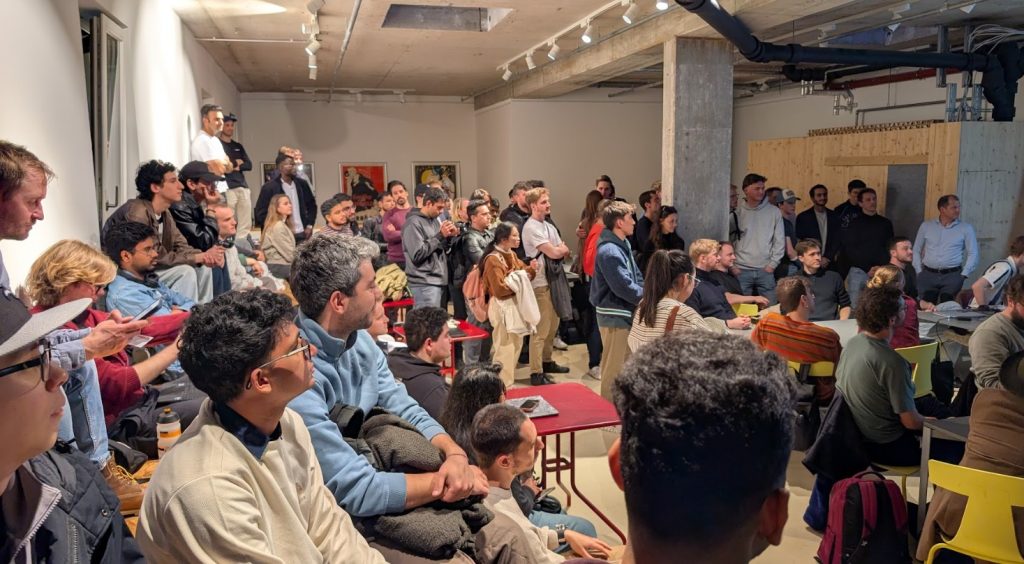
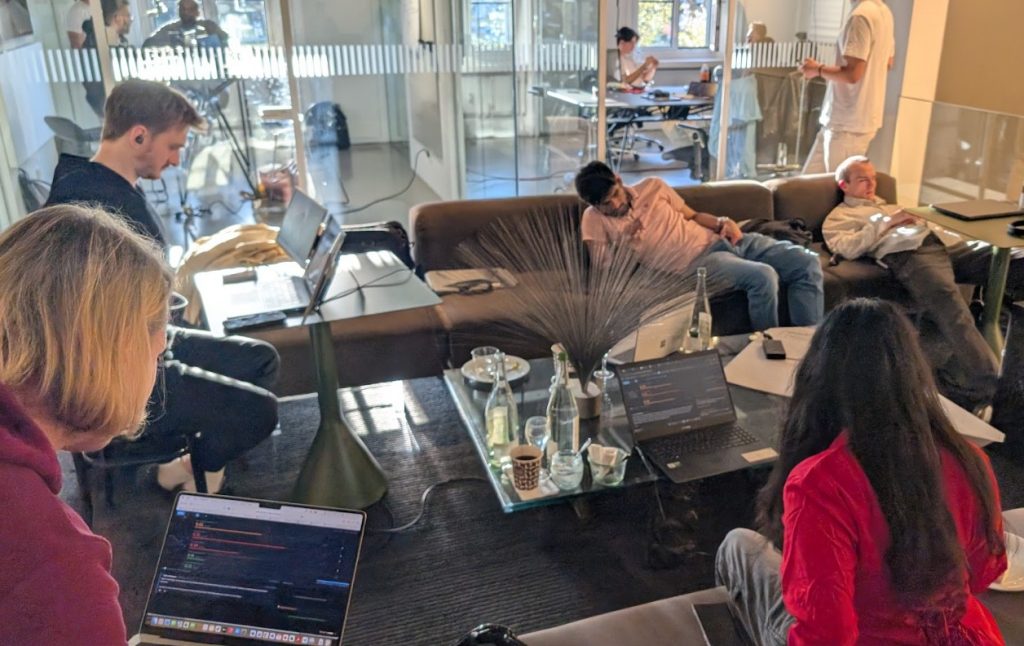
For 48 hours, participants worked in teams on ideas and prototypes related to pro-European values, public discourse, democratic resilience, and AI/ML as an enabling toolset. The atmosphere was focused, intellectually serious, and surprisingly generous. People arrived with different frustrations, different backgrounds, and different political and professional instincts. That was a strength, not a problem.
One insight stayed with us throughout the weekend: meaning does not simply wait somewhere to be found. It emerges in relationship, in conversation, and in the shared effort to understand something together. That is what made this format work. It created the conditions in which disagreement could become productive, expertise could travel across disciplines, and technology could be discussed in relation to the world we actually want to build.
What we learned
AGORAHACKS showed that there is far more talent, seriousness, and willingness to build in Europe than public pessimism often suggests.
Yes, the objections are real. People asked whether it makes sense to build democratic infrastructure using non-European tools, whether Europe is already too far behind, whether the necessary compute and capital exist. Those are fair questions. But this weekend offered a better response than abstract debate ever could: bring the right people together, give them a real problem, and watch what happens. (LinkedIn)
What happened in Munich was not naïve. It was difficult, demanding, and at times messy — exactly the way meaningful work usually is. But it also made one thing tangible: individuals are not powerless. People move. People connect. People build. And sometimes one sentence really does change everything: “Hey, I know someone you should meet.” That kind of organized serendipity is not a side effect. It is part of the infrastructure we need. (LinkedIn)

Jury
We are especially grateful to our jury members: Lisa Precht/IBM, Manon Westphal/TUM Think Tank, Philipp Baaske/LMU, Jasmin Riedl/BW Uni, and Moritz Eckert/Die ZEIT
Coaches, mentors, and contributors
A heartfelt thank you to everyone who shaped the weekend with their time, intelligence, and generosity, including: Fabian Heil, Tina Höfinghoff, Michael Gindert, Leo De Avila, Rob Benson, Philipp Baaske, Till Klein, Jasmin Riedl, Felix Heberle, Menelaos Panagiotis Fotiadis, Julius Riel, Elena Rostomashvili, Anamarija Kozina, Lukas Salecker, Magnus Strobel, Tilmann Vahle, Maximilian Nominacher, Niels Rolland, Jean-Marc Lieberherr Monnet, Manon Westphal, Patrizia Isabelle Nanz, Elvire Meier-Comte, Lisa Precht, Moritz Eckert, Benjamin Laepple, Josef Lentsch, Marco Janezic, and Vera Cornette — and, not least, the outstanding Luitpold staff, whose calm professionalism and warmth carried the event throughout. (LinkedIn)
What comes next
AGORAHACKS 26a is over. But what it activated should not end here.
The quality of the applicants, the energy of the selected participants, and the seriousness of the conversations all point in the same direction: this format deserves continuation. Not as a one-off signal, but as part of a broader effort to build the civic and technological infrastructure democratic societies increasingly need.
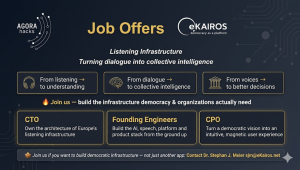
For eKairos, the weekend was both confirmation and invitation. Confirmation that the intersection of AI, discourse, and democratic resilience is not an abstract niche, but an urgent field of work. And an invitation to keep building — with partners, with institutions, with technologists, and with everyone who understands that better democracies will require better designed systems of listening, understanding, and exchange.
That is what AGORAHACKS 26a was about.
And that is why it felt, from beginning to end, like the start of something bigger.
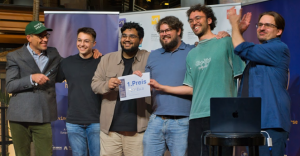
Preisträger 1. Preis für Recht AInfach, Christian Suslic, Felix Heß, Lukas Failer, and Taimoor Hussain.