
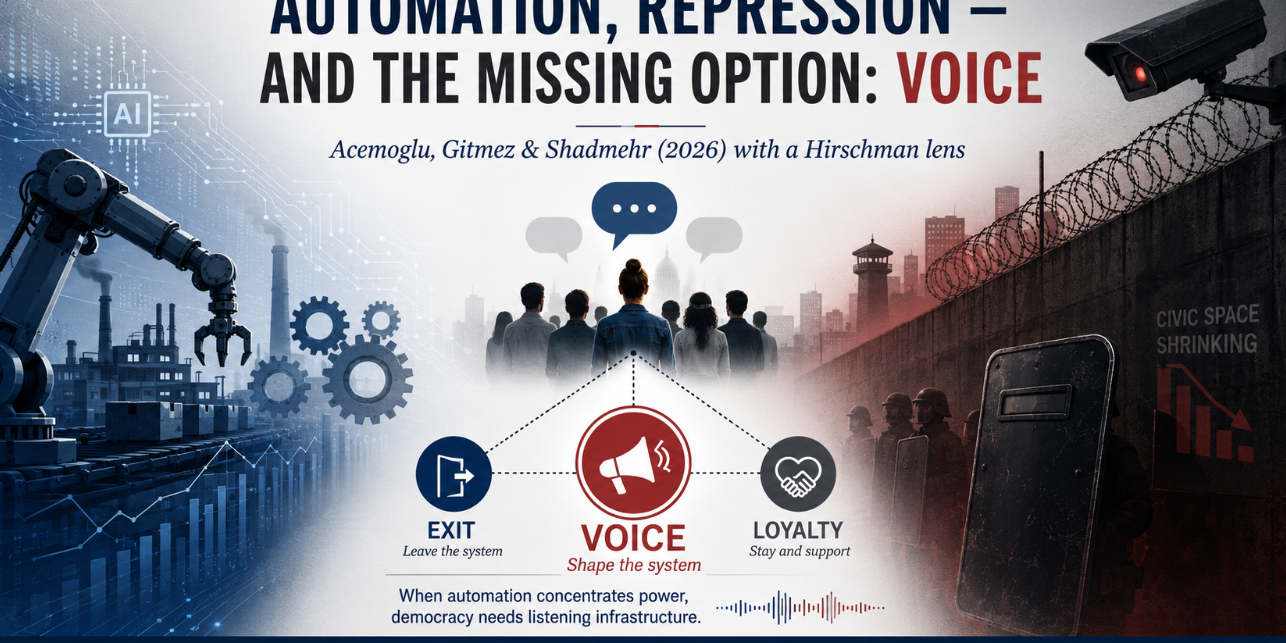
Automation, Repression — and the Missing Option: Voice
What happens when automation creates enormous economic gains, but those gains increasingly accrue to capital rather than labour?
A new NBER working paper by Daron Acemoglu, A. Arda Gitmez and Mehdi Shadmehr, Automation and Repression, examines precisely this question. Their theoretical model describes a troubling political dynamic: automation can increase inequality and therefore the risk of social revolt. Governments representing capital owners then face three broad choices — limit automation, redistribute its gains, or repress political opposition.
The authors’ central result is a complementarity between automation and repression. As automation and capital accumulation increase, redistribution becomes increasingly costly to capital owners, while repression may become comparatively more attractive. In an extension of the model, even a democracy can become vulnerable if economic power becomes sufficiently concentrated.
This is a theoretical model, not a prediction. But it raises a fundamental question for democratic societies:
What happens when those experiencing technological disruption feel they have no effective way to influence its course?
Here, Albert O. Hirschman offers an important additional perspective. His famous distinction between Exit, Voice and Loyalty reminds us that social stability depends not only on redistribution or the possibility of leaving a system, but on meaningful Voice: the ability to articulate dissatisfaction and influence institutions before frustration turns into withdrawal, revolt or coercion.
That is also why we believe Europe needs new listening infrastructure.
EchoPolis is designed to turn diffuse dissatisfaction into structured democratic voice: bringing people into human-to-human conversations, using AI to facilitate rather than replace dialogue, and translating many conversations into collective intelligence and institutional feedback.
Technology will transform work. The democratic question is whether citizens merely experience that transformation — or have institutions through which they can help shape it.
Automation needs more than innovation policy. It needs Voice.